I type about 30 mistakes a minute. My skills have not improved and I don't like to type, so I have posted a lot of pictures. However I will take some time and share some experiences. I think I will go with 2 groups: Good and Not So (good). You will have to check back here for the next 10 months as I will keep adding to it.
Good - The people here are friendly, at least outwardly. You walk down the street and everyone you pass greets you, "Buenos Dias or Buenas Tardes". With a smile, a warm greeting. You are expected to reply. So if you pass 4 people walking single file you greet each one - with a smile.
Not So - They are poor. I saw poverty in Mexico, but not to this extent. Many of the people live on q2000 - q3000 quetzales a month (300-400 dollars). Electricity is expensive. The 2 of us pay about $70 a month, but we have a washer, dryer, a/c in our bedroom, fridge, electric stove, and lights in every room. They have 1-2 lights, and 1-2 outlets, and maybe a fridge, and nothing else, and they pay up to $30 a month for electricity. Most people cook over fires. I need to get a pic of that on the blog.
Good - They are hard working, and don't complain about it. Most men get up at dawn, eat and head to work, returning at dusk - 10-12 hours a day, 6-7 days a week. There is more machinery here than I had expected (Caterpillars being used to build highways), still there is mostly manual labor. In making houses and buildings they use a lot of pumic block, cement, and rebar. I have been surprised at how fast the work goes. I have put pics of people carrying firewood on their backs. I have not heard anyone complain that they have to work.
Not So - They have to work for 6-7 days from sunup to sundown, and they make so little money that it is a trial to come to church on Sundays. Many make 50 quetzales a day (7 bucks) so they feel they have to work on Sundays. We teach them that the Lord's blessings to those who keep the Sabbath Day holy are worth a lot more than q50. Even for those who are active, doing more than going to church on Sunday doesn't happen much. Hometeaching and visiting teaching visits don't happen. They can't go during the week because of long work hours, and Sunday 3 hours for church, then cook dinner over a fire, eat and go to bed for the next day (it gets dark here at 6:30). It is good to have work (many don't), but it is sad so many can't do anything else.
Good - There are quite a few return missionaries here. Thinking back on my mission in Mexico City 43 years ago I cannot remember working in any ward or branch where there was a return missionary. Here a typical ward of 100 active members will have 2-5 return missionaries. That is a good resource for the leaders - missionaries who have served in different parts of Central America and know the gospel.
Not So - There is a high percentage of return missionaries who are not active. They come home and have to find work and they take what job they can find, often having to work on Sundays. That begins the decline. Often they marry someone who isn't a member and are so in love they don't care whether s/he is a member, or even getting married. Years later they find they have a family who knows very little about the church. We have met some who have been excomunicated. It is sad that having served a mission that someone else probably paid for, that somehow what they taught for 2 years didn't sink in.
Good - They have speed bumps about every 100 yards or so throughout the area. It keeps the cars from driving too fast. In Mexico there are no speed bumps and cars go too fast. Here it is slower. Most of the time we go between 15-25 mph. So our gas mileage is low.
Not So - They have speed bumps, even on some back streets that are full of rocks and pot holes, and you can't go over 15 mph anyway - they put in a speed bump! Sometimes I don't see the bump till we hit it, then hit the ceiling. It is worse when it is dark and raining. I hope we don't break our neck because of speed bumps. ☺ I will love going 65 mph on the freeway when we get home ☺
Good - The climate is such that anything grows here. It is cool to see the different kind of vegetation here.
Not So - The climate is such that anything grows here. A doctor explained that if you want to grow bacteria, this is the perfect environment - hot and humid. So there is a lot of illness here. We take great pains to be clean, especially with what we eat and how we prepare it. Many people here don't understand basic cleanliness, like washing your hands before you eat. We wash our hands first thing when we come home. Missionaries carry hand sanitizer with them. Think of all the dirty hands you shake during the day, the mini buses you take for transportion (not clean), the money you handle all the time, . . . So people here seem to get sick often.
Good - Buses here are 1.5 quetz in the city. That's about 20 cents. In other cities it is more.
Not So - Part of mission rules for cars is that we cannot give rides to people, unless they are going on visits with us. We have helped take some people to baptisms and to church. Most have never been in a real car except for the mini buses and taxis. We tell them to get in and they gently pull on the handle and nothing happens. I tell them, "Use some power", and they pull harder and the door pops open. The same scenario to get out. The younger kids especially are full of wonder when they get a ride to church. Today we took some pictures for a baptism invitation, and one girl said, "I want a picture with you two, right here with the car". ☺
Good - Missionaries in our mission baptize about 250 people each month, give or take. They are really pushed to work hard and baptize.
Not So - There is a high number of less active members. Our first week here I asked the bishop how many people came to church on a given Sunday. 150, sometimes more. Then I asked how many were on the rolls of the ward. about 900! I almost choked, and I had to ask a clarifying question before I understood what I had heard.
Assigned Home Teaching and Visiting Teaching routes don't exist as we know them. Bishoprics and R.S. presidencies make diligent efforts to visit people, but the rest of the members aren't involved. Which means the members don't get visited, so many of them go less active after a short time. Or sometimes after a long time.
So I tell the missionaries that our teaching has to improve. I tell them, "If you love them, teach them so they can understand the doctrine and stand on their own 2 feet, because if they need support they are unlikely to get it." Less than 30 percent of baptized members stay active.
Good - We went to visit a less active sister 6 weeks ago. After 14 years of being less active she has been coming to church every Sunday. She is SO happy. She has a 9 year old daughter. We have been teaching the mother, but when we do her daughter and nieces and nephews gather round to hear us. The missionaries have been teaching the daughter, Karen, preparing her for baptism. Her date is tomorrow. Today the missionaries went to fill out the baptism forms, and they asked her, "Who would you like to baptize you?" Right away she responed, "Elder Wetzel!" The Senior companion said that he would like to baptize her, and his companion said that he would like to baptize her. She responded, "Well I guess I will have to be baptized by all 3 of you ☺" I will post pics of the baptism next week.
Not So - When we first got her we didn't have a car, so we took the mini buses and mostly stayed in this area of town, going home when it got dark. About week 2 some missionary mentioned something about all of the bolos (drunks). We told him we had only seen one. Well since then we have seen a lot. It is sad. One day we were buying fruit in the street market, and laying right there was a drunk, laying down on the road. As we were getting the pineapple and melons, I saw his eyes flutter, and in a few moments he pushed himself up and started walking slowly down the road, but would lose his balance and almost fall, catch himself, over correct and zigzagged about 15 yards. Then he fell hard, hitting his head on the pavement, then layed still. Someone had to move his legs so a car could get by. We see drunks during the day (like him), and during the night. Doesn't seem to matter.
Good - I hear the rolling thunder. When it rains, it pours! For about an hour it is gushing downpour. Even with an umbrella you get wet from the waist down if you stay out in it. Many people seek shelter and just hang out there for an hour or so. While it is raining the streets are empty. As soon as it lets up there are people that come out of the woodwork. There is lots of thunder almost everyday. It seems the lowlands produce the warm air, which heads up the mountain and meets the cold air from the higher regions, and the booms and claps of thunder happen along the whole mountain range. We see plenty of lightening close by. Vicky still jumps at the loud claps of thunder.
Not So - It rains a lot. It is hard to get around in a downpour. Sometimes we have been teaching a family when it starts raining, so we just hang out there till it lets up enough for us to get out.
Good - It rains a lot. When it doesn't it heats up to 93 degrees. When it rains it will drop to the mid 80s.
Not sure - Mixed in with the Spanish there is a lot of English. "Car Wash" is common vocabulary. On billboards with commercial signs there is lots of English. Now that I remembered to write about it my mind went blank - come back in a few days and I will rewrite this.
There are lots of English names among the people . William (instead of Guillermo), Nancy, Brinker, Brian, Byron, Karen, Catherine, Henry, Elmer, MaryJane, Heidi, . . .
Not So - The new members don't receive callings very often. It is difficult to extend a calling to someone who only comes to church 2 - 3 times a month. Their reading level is low so its not like you can give them a teacher's manual and tell them to teach a class. One branch president expressed his frustration that he didn't feel he could ask more that 12 different people in his very large branch (attendance between 150-190) because the others don't know the gospel, they don't come all the time, and they chose to drop out of school so now they can't read. I like the branch president. He is a bit older but has long experience in the church.
Not sure - I am surprised how many people from here go to the U.S. The attitude strikes me different than in Mexico, where they know it is wrong and there is danger along the way. People here don't sense any wrong in going where there is work, spending a few years there, and coming back here to family and country. It is surprising how many people we meet who have lived in the states, and they greet us in English (I think) - their English is not good. There is a new member in the ward here who was born in Boston, and at 16 years old he came to Guatemala with his father. 12 years later he speaks Spanish like a native. I don't hear him speak English.
Not So - Some young couples make plans to get out of poverty. Their plan? He will leave his wife and children and go to the U.S. to work for 6 years, return to build a house and start a buisness. What usually results is disasterous. But it is hard to tell them that their life will be worse than it is. We met a guy who followed that plan, lived in L.A. for 12 years, always keeping enough money to live on and sending the rest to his wife and children here in Coatepeque. The money he sent them was used to build a house, which they did. But when he returned he found his wife with another man, they kicked him out of the house that his money had built, and now he is homeless. I recently heard a talk from a local leader here that emphasized that couples should stay together. So many men go to work in bigger cities in Guatemala, coming home on Sat. night, for one or 2 nights every 15 days. Not a great plan and the results are not good.
Good - There are more Spanish speaking missionaries than Americans. Most come from Honduras and El Salvador and Mexico, with some from Nicaragua, Costa Rica, and Peru. About 40% are American, with a few Canadians. Reminds me of a church video (film) where Pres. Spencer W. Kimball explains what he thinks missionary work could look like in the future - - > Today.
Not So - The branch and ward leaders don't have administration manuals, and their counselors don't either. The bishop and R.S. pres. usually have them. Those who have them don't read them. They are doing the best they know how, but it could be better. I ask them, "How can you learn your duty if you don't have the manual where the dutys are?" They ofter defer to someone who was a leader years ago, who probably doesn't know what the manual says either - refering to former bishops and current high council members. I have no authority, but sometimes I will point things out in the manual to them.
Good - You can't drink the water out of the tap, but we have 5 gallon bottles of water we use for drinking and cooking. The new top song on my list is, "COOL, CLEAR, WATER" from the Sons of the Pioneers. Nothing beats a tall glass of cool, clear, water when we come home. There is always a glass in the fridge that I can tip back let drizzle down my parched throat to cool me off.
Not So - There are lots of dogs in the streets. Very few are pure bred. As we drive around there will be dogs lying in the middle of the road, and as we come up to them they don't jump up and run away the way a dog in the States would. Rather they wait till I almost hit them, then slowly get up and barely move off to the side. I've come to the conclusion that the dogs are blind and deaf - they can't hear the car coming and they don't see it. Sometimes you will see a dog with its back leg(s) broken, from when it wasn't as fast as the car. I think people here are related to the dogs. There are few sidewalks, so people have to walk on the side of the road. But you would think that when they see a car coming they would get out of the way. They move, but not very far. Once as a passed a guy our mirror hit him.
Good - These are an easy going people, easy to love. They are poor, but not sad. The little kids are not aware of their poverty because everyone else is like them. They are hard working, getting up early, coming home 10+ hours later, bathing, eating, then going to bed to repeat it all the next day. Women cook the meals over fires. Meals are simple - corn tortillas that they make everyday, vegetables, chicken. As hard as they work I have not heard them complain about having to work hard.
Not So - There are not enough jobs. A decent job requires a person to finish the equivalent of Middle School. Then they could work in a store like Pizza Hut, or Wal-Mart, and make ok money and have a full time job. But so many don't have the schooling and can't even apply for something like that because they don't have an 8th grade education. We know several adults who are trying to finish 7th and 8th grade so they can have a job, but how do they pay the rent in the meantime? We tell the youth to get their studies done while they are young.



 The grandkids are a great-looking bunch. Our joy.

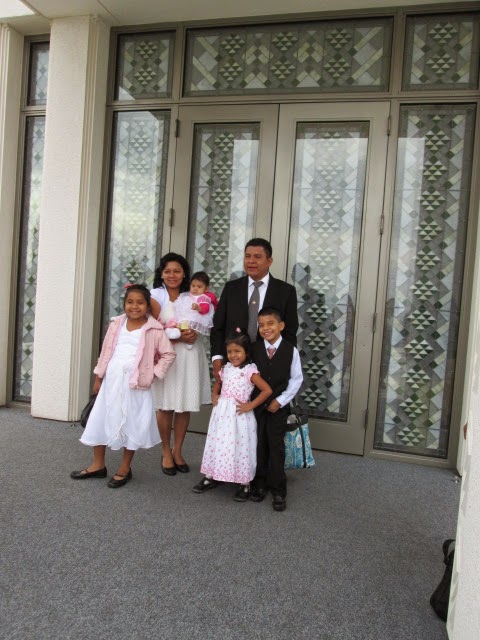
 A ward family that we visit: Alejandra, Rosario, Maria


 The Young Men put on a native dance.

 After the program Molly and her friends drove away together. This is very common, The most I have seen on a motorcycle is 5.
 Just to illustrate - that if you plant a stick in the ground it will grow. Soon this will be a natural fence.


 Julio Diaz baptized his son, Helaman. We are teaching the parents the lessons to prepare to go to the temple. Hopefully that will happen on Oct, 11.
 Sariah giving a wonderful talk on the Holy Ghost. She is 10.


